





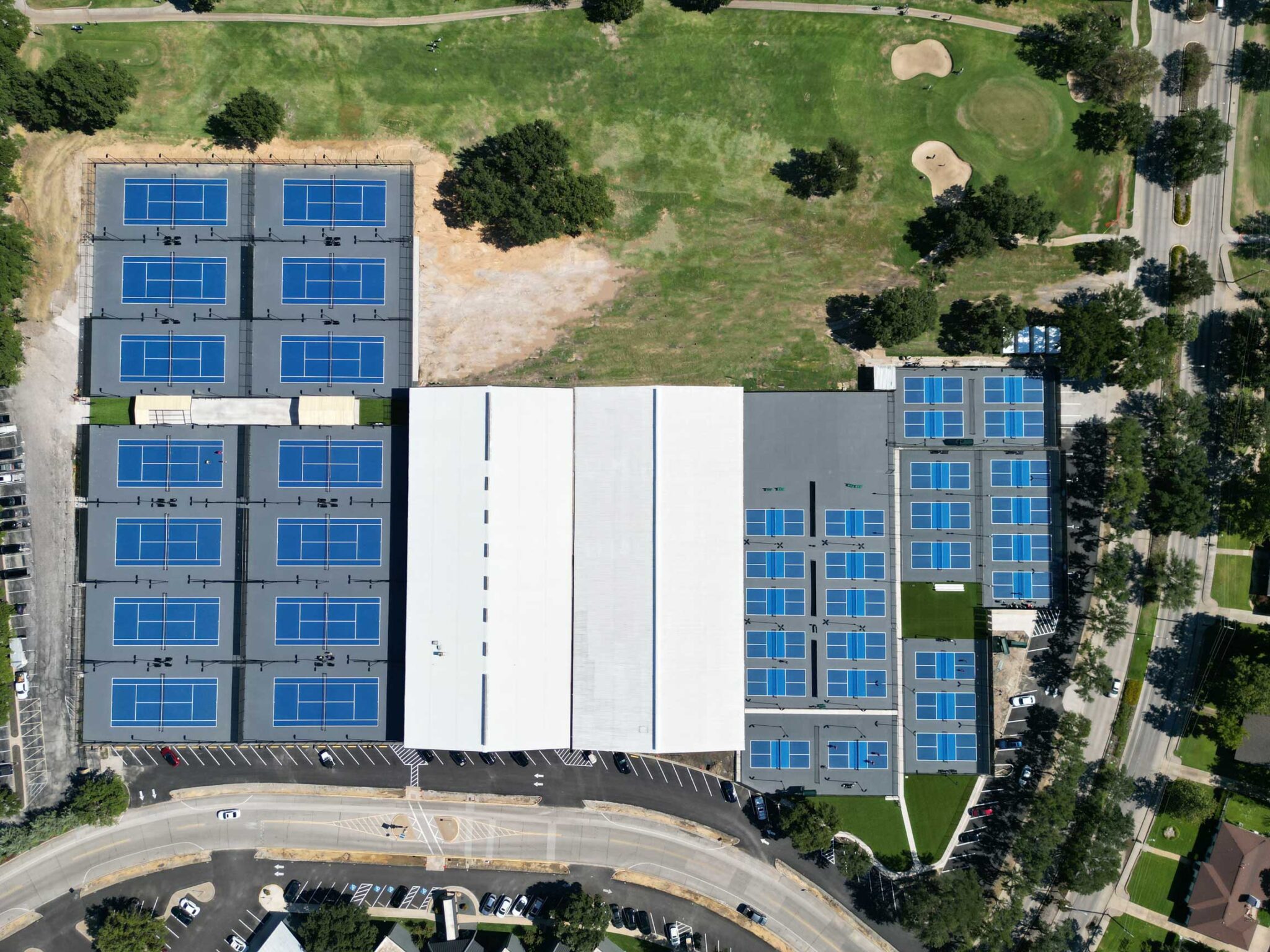
"Court paint" is a misleading name. What goes on a pickleball court is a 100% acrylic coating system — resurfacer, color coats loaded with graded sand, and textured line paint — engineered for grip, ball response, and UV survival. Regular paint checks none of those boxes, which is why every court painted with it looks great for a month and plays like ice in the rain.
The system, not a bucket
- Acrylic resurfacer: the foundation coat that fills texture and evens porosity.
- Color coats (2): 100% acrylic like Acrytech, with silica sand sized for pickleball's speed and footing.
- Line paint: textured white acrylic, masked to 2" lines — so the ball bounces true even on the line.
What makes a coating "pickleball spec"
Pickleball plays faster than tennis and the ball is harder. The sand load and gradation set the pace of the court: too smooth and it's slick, too coarse and it eats balls and knees. Acrytech systems are blended to the texture spec used on the PPA Tour — where AT Sports has been the official surface since 2020. That same spec ships in every pail.
Coverage math
For a standard 30'×60' court (1,800 sq ft)
- Resurfacer: ~2 coats ≈ 22–45 gallons
- Color: 2 coats ≈ 22–45 gallons depending on texture
- Rule of thumb: ~80 sq ft per gallon per coat
Run your exact size through our Project Calculator — it does the pail math for you.
Colors that work
Two-tone layouts — a contrasting kitchen — are the modern standard, and lighter surrounds run cooler in full sun. Preview any combination live in the Court Designer before you order.
DIY or installer?
Coating is honest work but unforgiving: squeegee technique, mix ratios, and weather windows all show up in the finish. If the court is an investment — a club, an HOA, a backyard build you want to last — a certified installer pays for itself. Find one near you, or call (770) 734-3000 and we'll spec your project either way.