





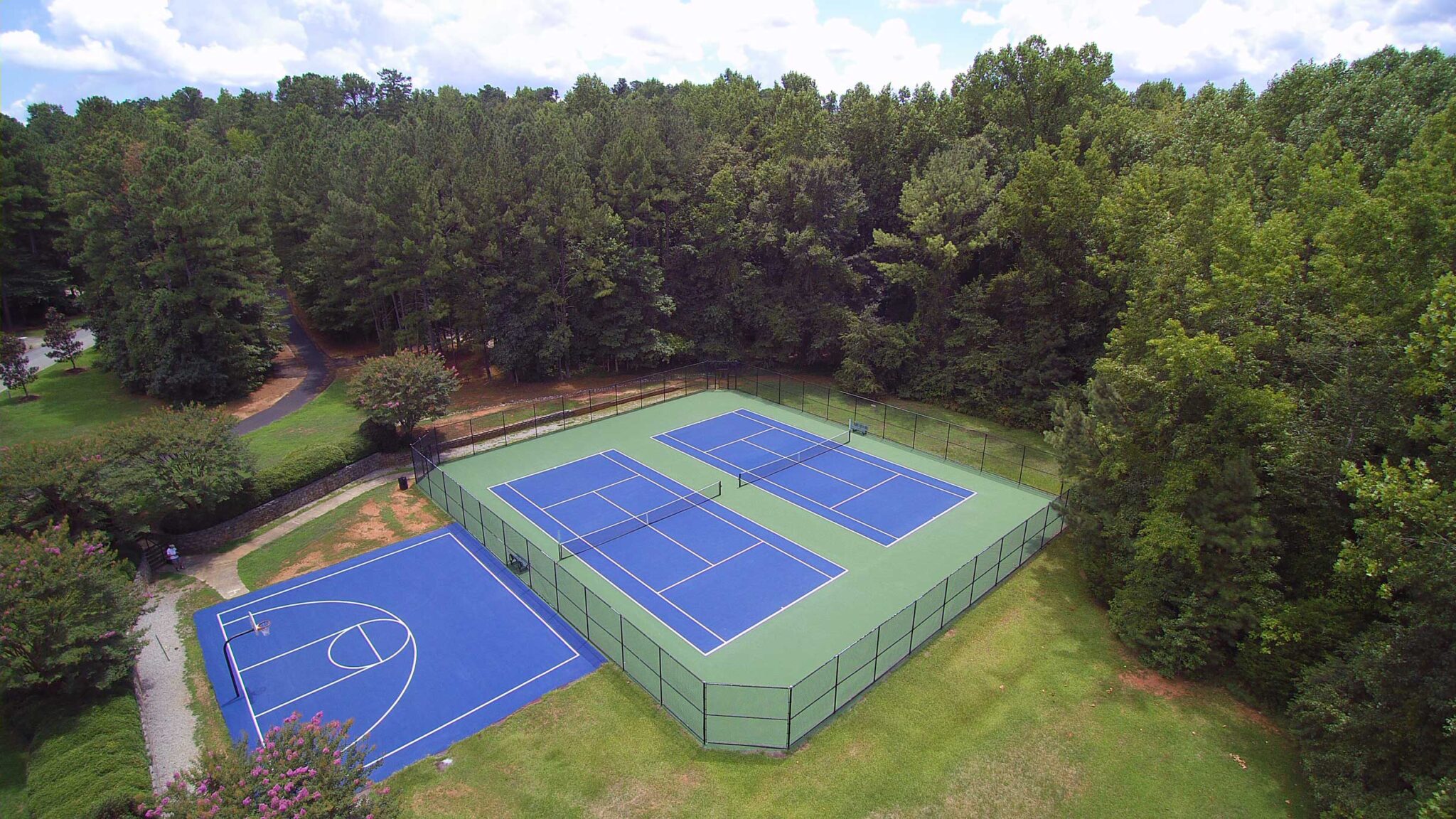
Acrylic coatings don't die of old age — they die of water. Water standing on the surface, or worse, water moving underneath it. The defense is set on pour day and it costs nothing extra to get right: 1% slope, one plane.
The 1% rule
A court should fall 1 inch every 8.3 feet — enough that rain sheets off, gentle enough that no one feels it. Critically, it falls in one plane: corner to corner as a single tilted sheet, never crowned in the middle like a road. Crowned courts drain into their own baselines, and side-to-side breaks put the fall across the play.
The flood test
One hour after rain (or a hose-down), walk the court. Any puddle deeper than a nickel — a "birdbath" — is a future coating failure marked in water. On new construction, flood-test before the coating goes down, while the finisher is still on the hook to fix it.
Under the slab matters too
- Compacted stone base under the pad gives subsurface water a path.
- Perimeter grading — the yard should fall away from the court, never toward it. Uphill courts need a swale or French drain on the high side.
- Vapor pressure — moisture rising through a slab lifts coatings from below. It shows up as blistering and is the classic sign of a court built in a wet spot without drainage.
Fixing a court that holds water
Shallow birdbaths get leveled with patch binder during a resurfacing. Widespread ponding or blistering means the slab or the site drainage is wrong — a patch will not outrun physics, and an honest assessment beats three rounds of cosmetic fixes. That's an installer conversation.
Building new?
The 1% plane, base stone, and perimeter plan are all in the construction guide — set them in the contract before the pour, and coating day goes the way it should.